SKF HN 4-16/SET Hook Spanner Set: Lock Nuts and Bearing Mounting Guide
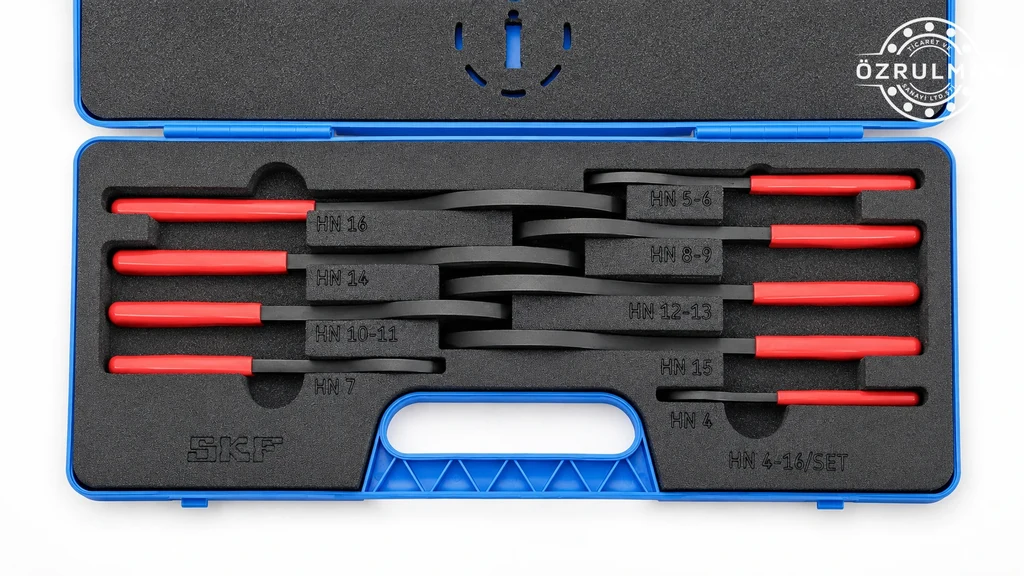
The SKF HN 4-16/SET is a mechanical maintenance set made up of nine fixed hook spanners used to tighten and loosen bearing lock nuts. SKF prepares the set to cover lock nut sizes from 4 to 16 and supplies the spanners in a sturdy carrying case.
The basic task of the HN series is to turn, in a controlled way, the lock nuts used in arrangements where bearings are mounted directly on the shaft or on sleeves. SKF also states that, depending on the application and bearing size, HN spanners can also be used to drive a bearing up a tapered seat.
This second use requires particular care. If a bearing is driven too far up a tapered seat, its internal clearance can be reduced excessively or eliminated altogether. SKF clearly states that this can lead to bearing damage. The HN 4-16/SET is therefore not just a nut spanner set but maintenance equipment that must be regarded as part of the correct mounting procedure.
Which spanners are in the SKF HN 4-16/SET?
According to SKF’s official product document, the set contains nine spanners:
| Spanner | Lock nut outside diameter |
|---|---|
| HN 4 | 30–32 mm |
| HN 5-6 | 38–45 mm |
| HN 7 | 52–55 mm |
| HN 8-9 | 58–65 mm |
| HN 10-11 | 68–75 mm |
| HN 12-13 | 80–90 mm |
| HN 14 | 92 mm |
| HN 15 | 95–100 mm |
| HN 16 | 105 mm |
These values show the spanner geometry based on DIN 1810 and the outside diameter of the suitable lock nut.
There is an important distinction here. The set is not a single spanner system adjustable to every diameter between 30 and 105 mm. Nine separate fixed spanners cover different groups of nuts. The user must therefore first determine the nut code or outside diameter and then select the suitable HN spanner.
Which nuts can the HN 4-16/SET be used with?
The main target of the set is SKF KM series lock nuts. SKF’s current maintenance catalogue defines the HN 4-16/SET for nut sizes from KM 4 to KM 16. According to the selection table, the same product family can also be matched with different N, AN, KMK, KMFE and KMT series and certain DIN 1804 nuts.
However, it is not right to assume that all HN spanners match with the same number in all nut series. For example, the outside diameter and slot geometry can differ between nut series. The maintenance team should therefore read the full code on the nut and compare it with the SKF selection table.
Design features of the SKF HN series
In the HN series SKF aims for the spanner to contact the nut circumference with a suitable radius. The manufacturer states that this geometry helps reduce the risk of damage to the shaft and nut.
HN spanners also have:
- a plastic handle resistant to oil, grease and dirt,
- a handle surface that gives a better grip,
- a plastic coating that reduces direct contact between metal and skin,
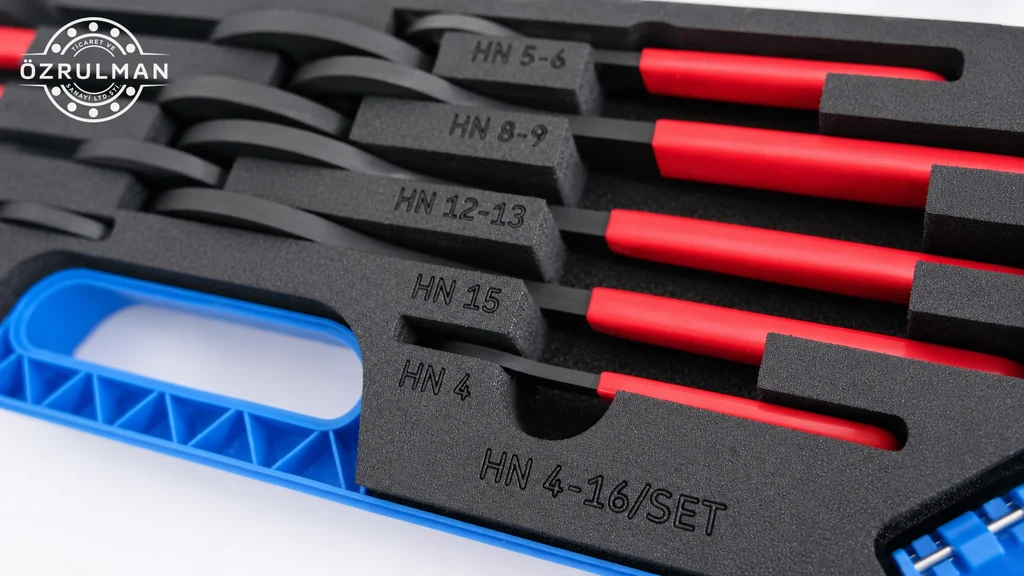
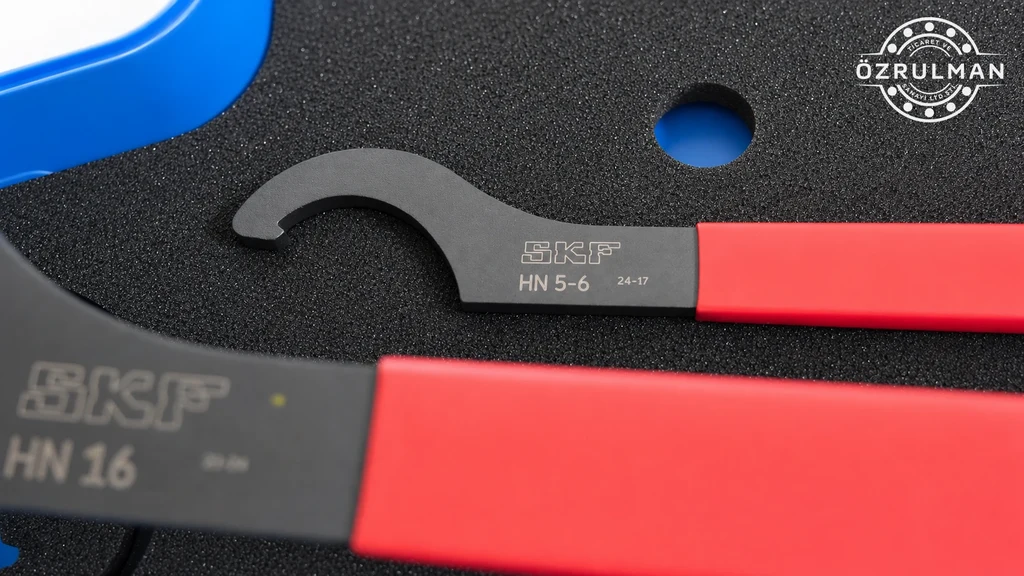
- laser marking that allows the spanner size to be recognized quickly
.
In the photographed set, the black spanner bodies, red handles and the separate spanner slots in the foam tray are clearly visible. Each slot is marked with a code such as HN 4, HN 5-6, HN 7. This layout helps in selecting the right spanner more quickly in the field.
What is a hook spanner used for?
A hook spanner, also commonly called a C spanner, is used to turn lock nuts that have slots or notches around their circumference.
Standard open-end spanners grip the outer surface of the nut. A hook spanner, on the other hand, contacts the slot around the circumference of the lock nut with the hook at its end.
In bearing applications, lock nuts can take on different tasks:
- securing the bearing axially on the shaft,
- tightening an adapter or withdrawal sleeve,
- driving the bearing up a tapered seat,
- adjusting the axial position in certain bearing arrangements.
Choosing the right spanner is therefore not only about being able to turn the nut. A hook spanner of the wrong size can make insufficient contact with the nut slot, damage its edges or cause the spanner to slip.
Why does bearing mounting on a tapered seat require care?
Bearings with a tapered bore can be mounted directly on a tapered shaft or with the help of an adapter or withdrawal sleeve.
As the bearing is driven up the tapered surface, the inner ring expands. As a result the internal clearance of the bearing decreases.
SKF therefore particularly emphasizes that the bearing must not be driven up too far. Excessive drive-up can eliminate the internal clearance completely and create unwanted preload in the bearing.
The technician should therefore not mount a bearing based only on the criterion “the nut looks tight”.
Depending on the bearing type, the following can be used:
- reduction in radial internal clearance,
- axial drive-up distance,
- a specified tightening angle,
- a hydraulic method,
- a manufacturer method such as the SKF Drive-up Method
.
The HN 4-16/SET is the mechanical tool that turns the nut in these operations. However, the spanner itself does not measure the correct mounting value.
Is the HN 4-16/SET a torque wrench?
No.
The HN 4-16/SET is a fixed hook spanner set. The product does not measure torque and does not show the user the applied Nm value.
If the application requires a specific torque value, a suitable torque-controlled method or another mounting method described by the manufacturer must be used.
Similarly, if bearing mounting has to be controlled by the reduction in radial internal clearance, the technician must use suitable feeler gauges, a measuring method or the relevant SKF mounting procedure.
This distinction is important. A hand tool transmits the mounting force; it does not verify the mounting criterion on its own.

What is the difference between the HN series and the HNA series?
The SKF HN series consists of fixed-size hook spanners.
The SKF HNA series, in contrast, uses adjustable hook spanners. With four HNA spanners, SKF offers a system that covers a wider group of nut sizes.
The advantage of the HN 4-16/SET is that it offers a separate, defined spanner geometry for each group of nuts. The maintenance team can select the right size directly from the set.
Which approach is more suitable depends on frequency of use, variety of nuts, the working area and the plant's maintenance standard.
Can standard HN spanners be used in SNL housings?
For the lock nuts inside SNL, FSNL, SNH and SE type housings, SKF develops the separate HN ../SNL series. This series has a special shape suited to working within the narrow housing geometry.
It should therefore not be assumed that the standard HN 4-16/SET can physically reach the nut inside every housing.
The Öz Rulman website also lists products from the same product family such as the HN 11/SNL SKF hook spanner and the HN 32/SNL SKF hook spanner. These products are concrete examples of the design difference between the standard HN series and SNL type applications.
Who is the HN 4-16/SET suitable for?
The set can be considered especially in the following working environments:
- industrial maintenance workshops,
- bearing mounting and dismounting stations,
- electric motor and gearbox maintenance teams,
- pump and fan maintenance services,
- mechanical maintenance departments of production plants,
- bearing service companies,
- machine building and commissioning teams.
However, if the nut sizes used in the plant are outside the HN 4 to HN 16 range, different HN or HNA spanners are required.
What should be checked when receiving the set?
When the physical set is received, the following checks can be made:
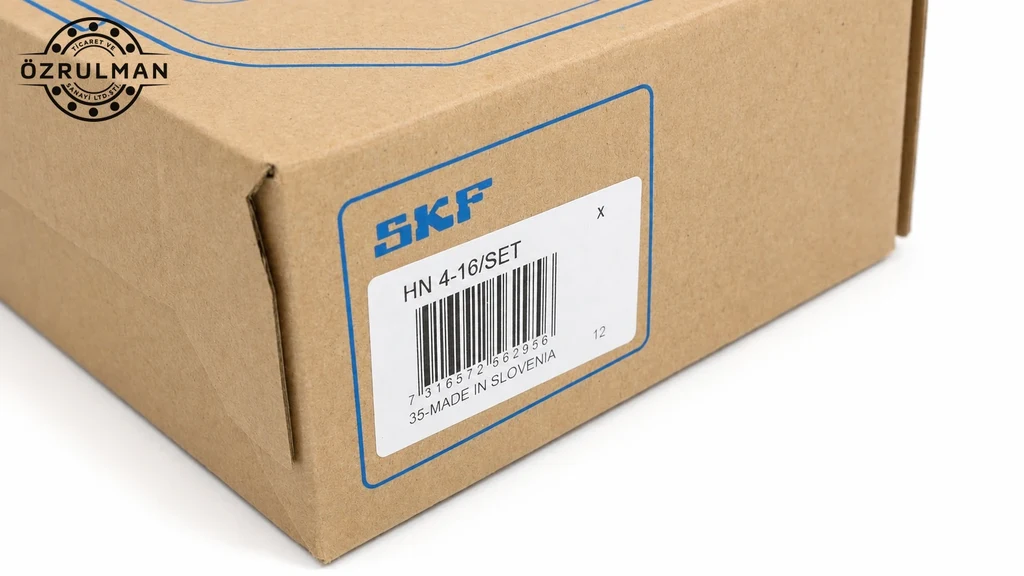
- Is the product code on the box
HN 4-16/SET? - Does it match the EAN
7316572562956? - Are all nine spanners present?
- Are the codes HN 4, HN 5-6, HN 7, HN 8-9, HN 10-11, HN 12-13, HN 14, HN 15 and HN 16 readable?
- Is there any impact damage or deformation on the hook tips?
- Are there any cracks or looseness in the handles?
- Are the laser markings legible?
- Are the carrying case and the inner foam tray undamaged?
- Is there any rust or heavy mechanical damage on the surfaces that contact the nut?
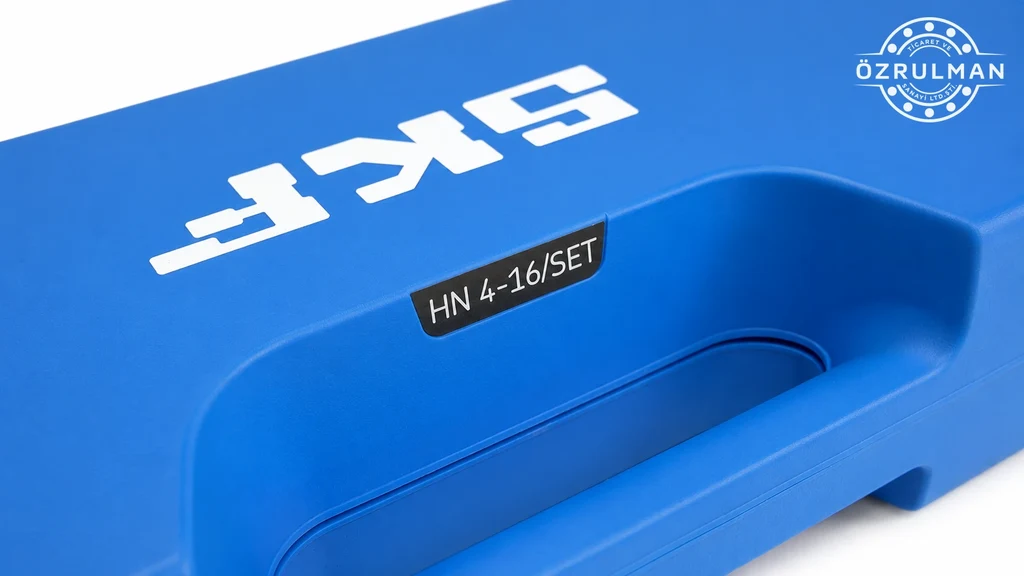
The box label of the photographed product clearly shows the product code, EAN and country of origin, Slovenia.
Why is the right tool important in bearing mounting?
In bearing mounting, transmitting force through the wrong point or damaging the fasteners can make later maintenance work more difficult.
SKF particularly highlights the fully matching spanner geometry of the HN series as a way to reduce the risk of damage to the shaft and nut.
However, the right tool alone is not a guarantee of correct mounting.
The maintenance team must also check:
- the shaft and nut threads,
- the bearing internal clearance,
- the mounting surfaces,
- the sleeve,
- the lubrication condition,
- the mounting drive-up,
- the manufacturer's procedure
.
Frequently asked questions
How many pieces is the SKF HN 4-16/SET?
The set contains nine fixed hook spanners. It covers nut sizes from HN 4 to HN 16.
Which spanners are in the set?
It contains HN 4, HN 5-6, HN 7, HN 8-9, HN 10-11, HN 12-13, HN 14, HN 15 and HN 16.
Which nuts is the HN 4-16/SET used with?
The main field of use is SKF KM 4 to KM 16 lock nuts. The SKF selection table also shows suitable HN sizes for different N, AN, KMK, KMFE, KMT and DIN 1804 nuts.
Do the spanners conform to the DIN standard?
SKF gives the spanner design of the HN series according to DIN 1810.
Does the HN 4-16/SET measure torque?
No. The set consists of mechanical hook spanners and does not measure torque.
Can it be used in tapered bearing mounting?
Depending on the application and bearing size, SKF HN spanners can be used to drive a bearing up a tapered seat. However, the mounting drive-up must be checked according to the relevant SKF procedure.
What is the EAN code of the set?
The EAN code is 7316572562956. SKF Authorised Distributor ACORN confirms this code for the HN 4-16/SET.
What is the origin of the set?
The photographed box carries the marking Made in Slovenia. The ACORN and RS product records also show Slovenia as the country of origin.
Links
- HN 0 SKF hook spanner
- HN 11/SNL SKF hook spanner
- HN 32/SNL SKF hook spanner
- Öz Rulman products
- SKF and other technical catalogues
- Quotation and contact
Latest Posts
- Unstable and High Angular Readings in Laser Shaft Alignment: Causes and Solutions (Field Case)
 If the angular misalignment on a laser shaft alignment tool changes from one measurement to the next while the parallel offset stays constant, the problem is usually in the setup. A real field case, likely causes and a step-by-step checklist.
- What Is a Machinery Shim? Shaft Alignment and Soft Foot Correction Guide with the SKF TMAS 100/KIT
 Correct alignment of rotating machinery is not completed just by measuring two shafts. The vertical deviation found by the measurement has to be corrected physically. To change the height of an electric motor, pump, fan, gearbox or any other rotating machine precisely, precision shims of specific thicknesses are placed under the machine feet. The SKF TMAS 100/KIT is a stainless steel 100 × 100 mm… Read more: What Is a Machinery Shim? Shaft Alignment and Soft Foot Correction Guide with the SKF TMAS 100/KIT
- Bearing Companies and Bearing Suppliers: How to Find the Right Product
 When an industrial bearing is needed, not everyone starts the search with a product code. A maintenance technician searches for the code on the bearing, while a purchasing department may use more general phrases such as bearing companies, bearing suppliers, bearing prices, or a city-based term such as Kayseri bearing dealer. In bearing supply, however, finding the product is not enough. Brand, bearing type, dimensions, internal clearance, sealing design, operating conditions… Read more: Bearing Companies and Bearing Suppliers: How to Find the Right Product
- SKF PCM 303430 E: PTFE Composite Plain Bearing Bush Technical Guide
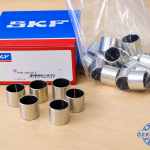 The SKF PCM 303430 E is a metric PTFE composite plain bush developed for compact bearing arrangements where the sliding contact principle is suitable instead of a rolling bearing. With a 30 mm bore and only a 34 mm outside diameter, and a nominal wall thickness of 2 mm, it forms a very compact bearing solution. However, this thin structure does not mean the product is designed for low loads… Read more: SKF PCM 303430 E: PTFE Composite Plain Bearing Bush Technical Guide
- Fast Dispatch from Stock for Industrial Spare Parts: Bearing Supply and DeliveryWhen a breakdown occurs on a production line, the first problem the maintenance team faces is not always diagnosing the fault. Even after the required part has been identified, not being able to find it or having to wait for its delivery can directly extend the maintenance time. For this reason, fast dispatch from stock for industrial spare parts should not be seen only as a logistics service. Having the right product in stock, checking the product code, preparing for dispatch… Read more: Fast Dispatch from Stock for Industrial Spare Parts: Bearing Supply and Delivery