What Is a Machinery Shim? Shaft Alignment and Soft Foot Correction Guide with the SKF TMAS 100/KIT

Correct alignment of rotating machinery is not completed just by measuring two shafts. The vertical deviation found by the measurement has to be corrected physically. To change the height of an electric motor, pump, fan, gearbox or any other rotating machine precisely, precision shims of specific thicknesses are placed under the machine feet.
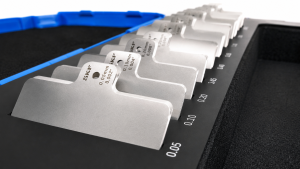
SKF TMAS 100/KIT is a professional set of stainless steel machinery shims, 100 × 100 mm in size, prepared for this task.
SKF describes machinery shims as thin alignment elements used especially for vertical machine alignment, precise adjustment of machine height and correction of parallel soft foot conditions. The shims are placed between the machine foot and the support surface.
For other alignment and maintenance solutions in SKF's official maintenance equipment product family, see the Öz Rulman Service and Maintenance Products group.
What is the SKF TMAS 100/KIT?
The SKF TMAS 100/KIT consists of pre-cut precision stainless steel shims used to change the height under machine feet in a controlled way.
Each shim has an outside size of 100 × 100 mm and a slot width of approximately 32 mm. The open U-shaped design makes it easier to place the shim under the machine foot, or remove it, in suitable applications without completely removing the mounting bolt.
In the TMAS series SKF uses close manufacturing tolerances, burr-free surfaces, thickness marking and stainless steel construction. This allows the technician to quickly select the shim that matches the required correction in the field.

What are the technical specifications of the SKF TMAS 100/KIT?
| Property | Value |
|---|---|
| Manufacturer | SKF |
| Product code | TMAS 100/KIT |
| Product group | Machinery Shims / Machinery shim set |
| Shim size | 100 × 100 mm |
| Slot size | 32 mm |
| Material | High-quality stainless steel |
| Thickness options | 0.05 / 0.10 / 0.20 / 0.25 / 0.40 / 0.50 / 0.70 / 1.00 / 2.00 mm |
| Total quantity | 170 shims |
| EAN / GTIN | 7316575901356 |
| Measurement system | Metric |
| Reusable | Yes, if in suitable condition and undamaged |
| Manufacturing / origin information | Bulgaria |
SKF's current catalogue defines the TMAS 100/KIT as 100 × 100 mm in size with nine different thickness combinations.
How many shims are in the TMAS 100/KIT box?
The kit is distributed as follows:
| Shim thickness | Quantity |
|---|---|
| 0.05 mm | 20 |
| 0.10 mm | 20 |
| 0.20 mm | 20 |
| 0.25 mm | 20 |
| 0.40 mm | 20 |
| 0.50 mm | 20 |
| 0.70 mm | 20 |
| 1.00 mm | 20 |
| 2.00 mm | 10 |
| Total | 170 |
This structure makes it possible to build different combinations, from very fine corrections to machine height adjustments of a few millimetres.
SKF also offers single-thickness refill packs as the kit is used up. For example, the code TMAS 100-005 stands for 0.05 mm, TMAS 100-050 for 0.50 mm, TMAS 100-100 for 1.00 mm and TMAS 100-200 for 2.00 mm shims. Each standard refill pack contains 10 shims. TMAS 100-300, with a thickness of 3.00 mm, is also available as a separate pack but is not part of the standard 170-piece content of the TMAS 100/KIT.

What is a machinery shim used for?
If the shafts of two machines connected by a coupling are not on the same axis, shaft misalignment occurs.
Misalignment is evaluated in two basic planes:
For vertical correction, the feet of the movable machine are raised or the existing shim thickness is reduced.
Horizontal correction, on the other hand, is made by moving the machine to the right or left on its base.
TMAS shims are used directly for the vertical correction.
For example, if a laser shaft alignment tool calculates that the front feet of the motor need to be raised by 0.20 mm and the rear feet by 0.50 mm, suitable shim combinations are placed under the feet. The mounting bolts are then tightened and the alignment is measured again.
Laser systems such as the SKF TKSA 31 Shaft Alignment Tool and the SKF TKSA 41 Shaft Alignment Tool can calculate the vertical and horizontal corrections required at the front and rear machine feet.
For the TKSA 41's measurement methods, soft foot check and alignment process, see also the SKF TKSA 41 Technical Specifications and User Guide.
What is soft foot and why is it checked before shaft alignment?
Soft foot is the condition in which not all of the machine's feet sit evenly on the support surface.
If a machine foot does not make full contact with the base, the machine casing can be strained or distorted when the mounting bolt is tightened. In that case, even if the laser alignment measurement looks correct, the position of the shafts can change again once the bolts are tightened.
Other alignment system manufacturers such as Easy-Laser and Acoem also describe the soft foot check as one of the basic checks to be made before shaft alignment. Easy-Laser states that soft foot can be caused by a twisted foundation, a damaged machine foot, an incorrect amount of shim, or dirt and foreign matter under the foot. Acoem emphasizes that it is extremely difficult to carry out a reliable shaft alignment without correcting soft foot.

What is the difference between parallel soft foot and angular soft foot?
In parallel soft foot, an approximately parallel gap forms between the machine foot and the base. A flat shim of the correct thickness can fill this gap and let the foot sit on the surface.
In angular soft foot, the machine foot sits on the support surface at an angle. Only one edge of the foot makes contact.
In this case, adding a single flat shim is not always enough. Depending on the application, step shimming, correcting the base or machining the foot may be required. Pruftechnik also states that angular soft foot requires more careful correction and that the step-shimming method can be used in some applications.
How should SKF TMAS shims be used?
Precision shimming is not just a matter of finding the total thickness required and putting metal under the machine. In a sound machine alignment process, the following sequence can be followed:
- The machine is stopped safely and the required safety procedures are applied.
- The machine foot, the foundation and the existing shims are checked for dirt, paint, oil residue and corrosion.
- The soft foot measurement is made.
- A shim size suitable for the machine foot and mounting bolt geometry is selected.
- The required shim thickness is prepared according to the vertical correction determined by the laser alignment tool or measurement method.
- It is placed under the machine foot using the fewest possible shims.
- The mounting bolts are tightened according to the manufacturer's procedure.
- Soft foot is checked again.
- The shaft alignment is measured again and fine correction is made if necessary.
- The final alignment values are recorded.
The SKF Bearing Maintenance Handbook recommends checking the support surface and machine base before shimming, measuring soft foot, and verifying the alignment again after the corrections.

How many shims should be placed under a machine foot?
This topic is particularly important.
SKF recommends using a single shim where possible and not stacking more than three shims. As the number of shims increases, the number of contact surfaces increases and the mechanical behaviour of the joint can change.
Pruftechnik's general field recommendation is to use three, and at most four, shims under a machine foot. Stacking many thin shims can create a flexible pack and cause a new soft foot problem known as squishy foot.
When using the SKF TMAS product, it is sensible to follow the stricter SKF recommendation:
A single shim if possible, a combination when necessary, but avoiding more than three shims.
For example, when a correction of 1.20 mm is required, a combination of 1.00 + 0.20 mm is a much more accurate approach than using twelve 0.10 mm shims.
How much of the machine foot should the shim support?
The shim should not act like a small washer just around the bolt. It must support the load of the machine foot over as wide an area as possible.
Pruftechnik recommends as good practice that the shim supports about 80 percent or more of the contact surface of the machine foot.
For this reason, when choosing the TMAS 100/KIT it is not enough to look only at the thickness needed. The suitability of the 100 × 100 mm outside size and the 32 mm slot design for the machine foot and mounting bolt should also be checked.
For smaller or larger machine feet, the SKF TMAS family also includes 50 × 50, 75 × 75, 125 × 125 and 200 × 200 mm shims.

Why should precision shims be used instead of randomly cut sheet metal?
During shaft alignment, corrections of a few hundred micrometres can be made. For this reason the actual thickness, flatness and surface quality of the shim used are important.
SKF TMAS shims:
- are made of stainless steel,
- have close thickness tolerances,
- are completely burr-free,
- are individually marked with their thickness,
- are pre-cut so that they can be easily fitted and removed in the field.
SKF also does not recommend using overly soft materials such as copper or brass as machinery shims. These materials can deform plastically under clamping load and cause looseness and changes in alignment over time.
This approach is not specific to SKF. Easy-Laser offers machine alignment shims with high-quality stainless steel, close tolerance and burr-free surface features, while Pruftechnik emphasizes that flat, corrosion-resistant stainless steel shims help provide stable machine support.
Can old shims be reused?
SKF states that high-quality stainless steel TMAS shims can be reused. However, this does not mean that every old shim can be reused without question.
Before a shim is reused, make sure its surface has:
no dirt, corrosion, bending, crushing, burrs or plastic deformation.
Pruftechnik specifically recommends cleaning the existing shims and the machine base before reassembly. Paint, dirt or corrosion left under the foot can cause squishy foot.
Can incorrect shaft alignment damage bearings?
Shimming alone does not determine bearing life, but it is one of the basic mechanical steps that help achieve correct shaft alignment.
Scientific studies show that shaft misalignment can create additional forces and vibration in rotating systems.
An experimental study published in 2025 showed that as parallel shaft misalignment increases, the vibration severity in the bearing system also increases, and that misalignment is directly related to the progression of bearing wear.
Earlier experimental and numerical studies have also shown that coupling misalignment creates additional reaction forces and vibrations in the rotor-bearing system.
These studies do not test the SKF TMAS 100/KIT. However, they mechanically support why correct machine alignment matters, of which the shim set is part of the solution.

Which machines can the SKF TMAS 100/KIT be used on?
The TMAS 100/KIT is not tied to a specific bearing type. It can be used on different rotating equipment as long as the machine foot size and the correction requirement are suitable.
Typical applications include electric motors, centrifugal pumps, fans, blower systems, gearboxes, compressors, coupled machine sets and various production machines.
In practice the shim set is mostly used together with a laser shaft alignment tool. The laser system measures how large the deviation is; the precision shims allow the calculated vertical correction to be applied at the machine foot.
The SKF TKSA 31 and the SKF TKSA 41 can be considered for the measurement side of this process. For a wider range of shim sizes, the SKF TMAS 510 Shim Set can also be reviewed.
SKF TMAS 100/KIT product code and stock information
SKF TMAS 100/KIT
EAN: 7316575901356
100 × 100 mm
170-piece precision shim set
Öz Rulman TMAS 100/KIT SKF listing

Manufacturer and technical sources
The current SKF Maintenance Products catalogue for the product's dimensions, kit contents and the TMAS product family:
SKF Maintenance Products Catalogue – TMAS Machinery Shims
Shim sizes, refill codes and technical specifications of the SKF TMAS product family:
SKF Machinery Shims TMAS Series technical table
For shimming, parallel soft foot, machine installation and shim count recommendations:
SKF Bearing Maintenance Handbook
Soft foot and precision shim applications from other manufacturers:
Easy-Laser – Precision Machine Shims
Pruftechnik – Stainless Steel Machine Alignment Shims
Pruftechnik – Soft foot symptoms, causes and correction principles
Acoem – Soft foot and shaft alignment pre-checks
For technical guides:
2025 – Shaft misalignment effects on bearing reliability, Results in Engineering
Effects of coupling misalignment on vibrations of rotating machinery, Journal of Sound and Vibration
Latest Posts
- Unstable and High Angular Readings in Laser Shaft Alignment: Causes and Solutions (Field Case)
 If the angular misalignment on a laser shaft alignment tool changes from one measurement to the next while the parallel offset stays constant, the problem is usually in the setup. A real field case, likely causes and a step-by-step checklist.
- What Is a Machinery Shim? Shaft Alignment and Soft Foot Correction Guide with the SKF TMAS 100/KIT
 Correct alignment of rotating machinery is not completed just by measuring two shafts. The vertical deviation found by the measurement has to be corrected physically. To change the height of an electric motor, pump, fan, gearbox or any other rotating machine precisely, precision shims of specific thicknesses are placed under the machine feet. The SKF TMAS 100/KIT is a stainless steel 100 × 100 mm… Read more: What Is a Machinery Shim? Shaft Alignment and Soft Foot Correction Guide with the SKF TMAS 100/KIT
- Bearing Companies and Bearing Suppliers: How to Find the Right Product
 When an industrial bearing is needed, not everyone starts the search with a product code. A maintenance technician searches for the code on the bearing, while a purchasing department may use more general phrases such as bearing companies, bearing suppliers, bearing prices, or a city-based term such as Kayseri bearing dealer. In bearing supply, however, finding the product is not enough. Brand, bearing type, dimensions, internal clearance, sealing design, operating conditions… Read more: Bearing Companies and Bearing Suppliers: How to Find the Right Product
- SKF PCM 303430 E: PTFE Composite Plain Bearing Bush Technical Guide
 The SKF PCM 303430 E is a metric PTFE composite plain bush developed for compact bearing arrangements where the sliding contact principle is suitable instead of a rolling bearing. With a 30 mm bore and only a 34 mm outside diameter, and a nominal wall thickness of 2 mm, it forms a very compact bearing solution. However, this thin structure does not mean the product is designed for low loads… Read more: SKF PCM 303430 E: PTFE Composite Plain Bearing Bush Technical Guide
- Fast Dispatch from Stock for Industrial Spare Parts: Bearing Supply and DeliveryWhen a breakdown occurs on a production line, the first problem the maintenance team faces is not always diagnosing the fault. Even after the required part has been identified, not being able to find it or having to wait for its delivery can directly extend the maintenance time. For this reason, fast dispatch from stock for industrial spare parts should not be seen only as a logistics service. Having the right product in stock, checking the product code, preparing for dispatch… Read more: Fast Dispatch from Stock for Industrial Spare Parts: Bearing Supply and Delivery