SKF PCM 303430 E: PTFE Composite Plain Bearing Bush Technical Guide

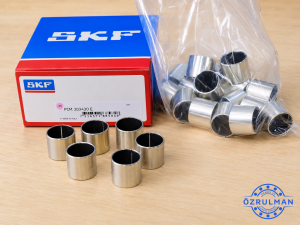
The SKF PCM 303430 E is a metric PTFE composite plain bush developed for compact bearing arrangements where the sliding contact principle is suitable instead of a rolling bearing.
With a 30 mm bore and only a 34 mm outside diameter, and a nominal wall thickness of 2 mm, it forms a very compact bearing solution. However, this thin structure does not mean the product is designed for low loads. The SKF product table gives the PCM 303430 E a basic dynamic radial load rating of 69.5 kN and a basic static radial load rating of 220 kN.
But when selecting a plain bearing, it is not right to look only at these two numbers.
In plain bearings, the real operating condition is determined by
load + motion + sliding speed + temperature + counter surface + alignment + operating time
together.
In this technical note, using the SKF PCM 303430 E as an example, we will cover the structure of PTFE composite plain bearings, their working principle, installation conditions and the points to watch for during selection.
To review other bearing solutions at Öz Rulman, you can browse the Bearings product group.
/product-category/rulmanlar/
What is the SKF PCM 303430 E?
The SKF PCM 303430 E is a metric plain bearing bush with a PTFE composite sliding surface.
The product is developed especially for bearing arrangements carrying radial loads, in applications where the motion takes the form of low-speed rotation or oscillation.
One of the important differences of the PCM .. E series is that it does not require initial lubrication. Thanks to the PTFE-based material on the sliding surface, the product can be used according to the dry-running principle and has no need for regular relubrication.
This feature can provide an important design advantage in machines where it is difficult to create a greasing point or where regular lubrication maintenance is to be reduced.
The term “maintenance-free” needs to be interpreted correctly here.
The product does not require relubrication. However, this does not mean that the bearing arrangement is independent of installation, alignment, shaft surface, temperature and contamination conditions.
What are the technical specifications of the SKF PCM 303430 E?
According to SKF's product data, the basic technical values of the PCM 303430 E are as follows:
| Technical specification | Value |
|---|---|
| Brand | SKF |
| Product code | PCM 303430 E |
| Product type | Plain bearing bush |
| Material | PTFE composite |
| Bore diameter, d | 30 mm |
| Outside diameter, D | 34 mm |
| Width, B | 30 mm |
| Nominal wall thickness | 2 mm |
| Basic dynamic radial load rating, C | 69.5 kN |
| Basic static radial load rating, C0 | 220 kN |
| Approximate product weight | 45 g |
| Initial lubrication | Not required |
| Relubrication | Not required |
| Maintenance class | Maintenance-free |
| Main load direction | Radial |
| Basic motion type | Slow rotation and oscillation |
These values define the technical capacity of the product. The actual permissible load in the application, however, must be evaluated separately according to the speed of motion, temperature, shaft surface, operating time and other design variables.
What does the PCM 303430 E product code tell you?
SKF's PCM family refers to metric plain composite bearing bushes.
The dimension part of the code PCM 303430 E is directly related to the basic dimensions of the product:
- 30 mm bore diameter
- 34 mm outside diameter
- 30 mm width
The E at the end indicates the design variant that uses PTFE composite sliding material.
The same SKF product family also includes different variants with POM composite material. For this reason, matching dimensions alone does not mean the products are direct alternatives to each other.
The material structure and working principle must always be checked.
What materials are inside a PTFE composite bush?
The operating character of the PCM .. E series cannot be explained by the metal surface visible from the outside alone.
The SKF PTFE composite bush structure consists of three basic layers:
- Steel backing
- Porous sintered tin/bronze intermediate layer
- Sliding layer containing PTFE and molybdenum disulphide
The steel backing forms the mechanical load-carrying structure of the bush.
A porous tin/bronze layer approximately 0.2 to 0.4 mm thick is sintered onto it. During manufacture these pores are filled with a mixture of PTFE and molybdenum disulphide.
There is also a thin running-in layer on the sliding surface.
This layered structure combines the mechanical strength of the metal body with the low-friction sliding properties of the PTFE mixture in the same thin-walled component.
Why are PTFE and molybdenum disulphide used?
PTFE is a polymer widely used in tribological applications because of its low friction character.
In SKF's E material variant, PTFE together with molybdenum disulphide forms the basis of the sliding layer.
This structure reduces the need to build up a separate continuous grease film on the contact surface. For this reason the PCM .. E series can operate without initial lubrication.
As a result, the designer can eliminate some maintenance requirements such as:
- grease channels,
- regular greasing points,
- a relubrication schedule
.
However, this advantage does not compensate for a wrong shaft surface or a badly aligned bearing arrangement.
What does a maintenance-free bush mean?
The term “maintenance-free” is sometimes wrongly interpreted as “no condition needs to be checked at all”.
For the PCM .. E the correct meaning is simpler:
The bush does not require planned relubrication during its service life.
Even so, the following conditions still matter in the system design:
- shaft surface quality
- shaft and housing tolerances
- alignment of the bearings
- temperature
- operating load
- sliding speed
- environmental contamination
- avoiding edge loading
In other words, the need for maintenance decreases, but the need for engineering does not disappear. Unfortunately, mechanical design does not retire the moment “maintenance-free” is printed on the box.
What kinds of motion is the SKF PCM 303430 E suitable for?
SKF positions the PCM .. E series especially for:
slow rotating motion
and
oscillating motion
.
In oscillating motion the shaft does not make a full revolution but moves back and forth within a certain angular range.
This kind of motion can be seen in:
- mechanical joints
- pivot points
- adjustment mechanisms
- linkage arms
- slow-moving machine elements
.
However, the statement “can be used in this type of application” does not mean it is automatically suitable for every application. The actual load and tribological operating conditions of the application must be calculated separately.
Can the PCM 303430 E carry axial load?
The PCM 303430 E is a plain cylindrical bush, and SKF defines this product family for carrying radial loads.
If axial location or an axial sliding surface is required, a plain bush alone may not be a suitable solution.
SKF's same composite bearing family includes different geometries such as:
- flanged bushes
- thrust washers
- composite strips
.
For this reason, in an arrangement where radial and axial loads are present together, the whole bearing arrangement should be evaluated instead of selecting only a plain PCM bush.
How can a thin-walled bush carry such a high load?
The nominal wall thickness of the PCM 303430 E is only about 2 mm.
Even so, the SKF product table gives a basic dynamic radial load rating of 69.5 kN and a basic static radial load rating of 220 kN.
The main reason for this is the composite structure.
While the steel backing supports the load mechanically, the sintered bronze intermediate layer and the PTFE sliding surface take on the tribological task during motion.
For this reason composite bushes become an attractive option in applications that need high load capacity within a limited radial space.
However, the catalogue load ratings should not be taken as equal to the directly permissible load on the machine.
In plain bearing calculations, factors such as specific pressure and sliding speed must be evaluated together.
What do the dynamic and static load ratings mean?
The values given for the PCM 303430 E:
69.5 kN dynamic load rating
and
220 kN static load rating
are basic catalogue parameters used for comparing the product and for design calculations.
The static value does not mean “220 kN can be applied to the bush continuously”.
Similarly, the dynamic load rating on its own does not tell the service life.
Some of the important parameters that determine performance in plain bearing applications are:
- average pressure on the bearing
- sliding speed
- the operating condition formed by pressure and speed together
- temperature
- character of the motion
- surface roughness
- whether the load direction is fixed or variable
For this reason, selecting a bush by looking at the largest number in the catalogue is not a sound engineering method.
What are the operating limits of PTFE composite material?
In SKF's PTFE composite material table, the general material characteristics are given as:
- maximum sliding speed up to 2 m/s
- material temperature range between -200 °C and +250 °C
- coefficient of friction between 0.03 and 0.25
.
These are the general limits of the material family.
It does not mean that the PCM 303430 E can operate at all of these values at the same time in a particular application.
For example, the permissible sliding speed can decrease under high load. The shaft material, surface quality, temperature and continuous operating time also affect the real operating limits.
For this reason the application design should be made according to the intersection of the product's catalogue limits.
How is friction controlled in a bush that runs without oil?
In a classically lubricated bearing, an oil or grease film is used to reduce contact between the metal surfaces.
In a PTFE composite bush, the material of the sliding surface itself takes on a significant part of the tribological task.
During initial running, the thin PTFE mixture on the surface comes into contact with the counter surface. Thanks to this operating character, no separate initial greasing is needed.
For this reason the PCM .. E series can be used in dry plain bearing applications.
But “dry running” does not mean that surface quality is unimportant.
On the contrary, the counter surface is one of the important design elements for the life of a PTFE composite bearing.
Why is the shaft surface so important?
In a plain bearing the shaft is not merely a geometric connecting element.
The shaft surface is directly the other side of the sliding pair.
For PTFE composite bushes, SKF recommends a low surface roughness on the counter surface. The general recommendation for PTFE composite material is:
Rz ≤ 3 µm
and
Ra ≤ 0.4 µm
.
A smoother counter surface can improve running and wear behaviour.
A very rough shaft surface, on the other hand, can cause unnecessary wear in the sliding layer.
For this reason, simply fitting a new bush and leaving a worn, scratched or wrongly machined shaft as it is is not always the right solution.
How should shaft and housing tolerances be selected?
SKF's general recommendation for metric PTFE composite bushes is:
H7 for the housing bore
and, for shaft diameters up to 75 mm:
f7 for the shaft
tolerance.
The 30 mm bore of the PCM 303430 E falls within this range.
The purpose of these tolerances is to create the required operating clearance after installation and to ensure the bush is held correctly in the housing.
If a different clearance is needed for a specific application, a separate evaluation should be made taking the temperature and operating conditions into account.
What should be done to avoid damaging the bush during installation?
Because composite bushes are thin-walled, the installation method is important.
SKF recommends using a lead-in chamfer of about 10 to 15 degrees on the shaft end and the housing bore.
This chamfer
- pressing the bush into the housing
- inserting the shaft into the bush
makes both easier and reduces the risk of damage to the sliding surface during installation.
The bush should not be fitted into the housing by hitting it uncontrollably with a hammer.
Using a suitable mandrel or pressing tool provides a more controlled installation.
Can the bore of the bush be machined after installation?
SKF manufactures PTFE composite bushes ready for installation.
Re-machining the sliding surface or enlarging the bore can reduce the PTFE working layer and may therefore have a negative effect on service life.
For this reason, re-machining the bore should only be considered in exceptional cases.
If a bore correction is unavoidable, SKF recommends a suitable calibration method instead of conventional machining.
So the approach of “the bush came out a bit tight, let's just run a reamer through it” is not an innocent workshop solution for this product family.
Why is alignment important?
In PTFE composite bushes the load must be distributed as evenly as possible across the width of the bush.
When the shaft and bearing housing are not correctly aligned, the contact can concentrate on one edge.
This creates edge loading.
SKF states that correct alignment of the bearing points is important, especially for PTFE composite bushes running without lubrication.
In applications where misalignment is unavoidable, the bearing geometry should be designed accordingly.
For this reason, the high catalogue load capacity of the bush should not be used as a safety margin to compensate for poor alignment.
What is the difference between a PTFE composite bush and a POM composite bush?
SKF's composite plain bearing family has two main different sliding materials:
PTFE composite, E variant
and
POM composite, M variant.
The PTFE composite structure does not require initial lubrication and is suitable for maintenance-free dry running.
The POM composite design, on the other hand, requires initial lubrication. In return, the thicker POM sliding layer can make it more tolerant of some misalignment and edge loading conditions.
Therefore, even if the dimensions of products with E and M codes are the same, their operating characters are not.
The material should be selected according to the real operating conditions of the application.
What is the difference between a plain bearing and a ball or roller bearing?
A plain bearing and a rolling bearing approach the same problem with two different mechanical principles.
In a rolling bearing the motion takes place through the rolling of balls or rollers.
In a plain bearing, on the other hand, two surfaces slide over each other in a controlled way.
Some advantages of PTFE composite bushes are:
- very small radial installation space
- simple structure
- low number of parts
- high radial load capacity
- use without lubrication
- potential for quiet operation
- suitability for oscillating motion
Rolling bearings, on the other hand, may be more suitable under conditions such as high speed, low rolling resistance and different load combinations.
- Unstable and High Angular Readings in Laser Shaft Alignment: Causes and Solutions (Field Case)
 If the angular misalignment on a laser shaft alignment tool changes from one measurement to the next while the parallel offset stays constant, the problem is usually in the setup. A real field case, likely causes and a step-by-step checklist.
- What Is a Machinery Shim? Shaft Alignment and Soft Foot Correction Guide with the SKF TMAS 100/KIT
 Correct alignment of rotating machinery is not completed just by measuring two shafts. The vertical deviation found by the measurement has to be corrected physically. To change the height of an electric motor, pump, fan, gearbox or any other rotating machine precisely, precision shims of specific thicknesses are placed under the machine feet. The SKF TMAS 100/KIT is a stainless steel 100 × 100 mm… Read more: What Is a Machinery Shim? Shaft Alignment and Soft Foot Correction Guide with the SKF TMAS 100/KIT
- Bearing Companies and Bearing Suppliers: How to Find the Right Product
 When an industrial bearing is needed, not everyone starts the search with a product code. A maintenance technician searches for the code on the bearing, while a purchasing department may use more general phrases such as bearing companies, bearing suppliers, bearing prices, or a city-based term such as Kayseri bearing dealer. In bearing supply, however, finding the product is not enough. Brand, bearing type, dimensions, internal clearance, sealing design, operating conditions… Read more: Bearing Companies and Bearing Suppliers: How to Find the Right Product
- SKF PCM 303430 E: PTFE Composite Plain Bearing Bush Technical Guide
 The SKF PCM 303430 E is a metric PTFE composite plain bush developed for compact bearing arrangements where the sliding contact principle is suitable instead of a rolling bearing. With a 30 mm bore and only a 34 mm outside diameter, and a nominal wall thickness of 2 mm, it forms a very compact bearing solution. However, this thin structure does not mean the product is designed for low loads… Read more: SKF PCM 303430 E: PTFE Composite Plain Bearing Bush Technical Guide
- Fast Dispatch from Stock for Industrial Spare Parts: Bearing Supply and DeliveryWhen a breakdown occurs on a production line, the first problem the maintenance team faces is not always diagnosing the fault. Even after the required part has been identified, not being able to find it or having to wait for its delivery can directly extend the maintenance time. For this reason, fast dispatch from stock for industrial spare parts should not be seen only as a logistics service. Having the right product in stock, checking the product code, preparing for dispatch… Read more: Fast Dispatch from Stock for Industrial Spare Parts: Bearing Supply and Delivery