
NFS40 One-Way Clutch: 40x90x33 mm Dimensions, Operating Principle and Mounting
NFS40 is a mechanical one-way clutch that transmits torque in one direction and allows freewheeling in the opposite direction. In industry this product group goes by different names such as one-way bearing, free-running clutch, cam clutch, freewheel clutch, overrunning clutch and backstop clutch. Technically, however, the NFS40 is not a standard bearing that carries radial and axial loads on its own. The application additionally requires suitable bearing support, lubrication and a sealing arrangement.
The common basic dimensions of products offered under the NFS40 code are a 40 mm bore diameter, a 90 mm outside diameter and a 33 mm width. However, the NFS40 code is not a unique product number belonging to a single manufacturer. Morse, FIJ, MOTN and different manufacturers may use the same or a similar code. Torque capacity, permissible speed, lubricant, fit tolerance and internal mechanism can therefore vary by brand.
For this reason, when researching a price or an equivalent, the user should share not only the NFS40 code but also the brand and series markings on the product. The Öz Rulman team can check stock, price, lead time and technical matching based on the full code and a photograph of the product.
NFS40 technical information
| Technical specification | General / verified information |
|---|---|
| Product code | NFS40 |
| Product group | One-way clutch / freewheel clutch |
| Common market name | One-way bearing |
| English names | One-way clutch, freewheel clutch, overrunning clutch, backstop clutch |
| Bore diameter | 40 mm |
| Outside diameter | 90 mm |
| Width | 33 mm |
| Mode of operation | Locking and torque transmission in one direction, freewheeling in the opposite direction |
| Basic types of use | Overrunning, indexing and backstopping |
| Bearing support | External bearing support required |
| Radial and axial load | The clutch does not carry them directly; separate bearings must carry them |
| Lubrication and sealing | Provided separately according to the manufacturer variant and the application |
| Brand | Must be verified from the physical product and packaging |
Technical data warning: Different torque and speed values for the NFS40 can be found on the internet. The reason is that the same code is used in different manufacturers’ and design variants. Do not apply a single torque or limiting speed value to all NFS40 products before the brand of the physical product is established.
Is the NFS40 a sprag type or a ramp and roller type?
On the market, NFS40 products are often described as a “sprag type one-way clutch”. In contrast, some manufacturers classify the same dimension family as a cam clutch or a ramp and roller clutch. For example, Morse defines the NFS series as a cam clutch. The ASNU40 from Formsprag/Stieber falls in the ramp and roller clutch class.
This distinction is not merely a matter of naming. Although sprag, cam and roller clutches perform the same basic task, their contact geometries, torque capacity, overrunning speed and lubrication requirements can differ. It would therefore not be correct to classify the internal mechanism with certainty without opening the product or seeing the manufacturer’s documentation.
The technical article and product page at Öz Rulman should therefore use the term one-way clutch in the main heading. In addition, to match the way users commonly search, the terms one-way bearing, sprag clutch and freewheel clutch should also appear in the text in natural context.

How does a one-way clutch work?
A one-way clutch switches between two different operating states depending on the direction of relative rotation between the inner and outer rings. In the locking direction, the cams, sprag elements or rollers move into the narrowing contact zone. The elements then wedge between the rings and form a frictional connection. The clutch thus transmits torque from one ring to the other.
In the opposite direction, the wedging elements move away from the narrowing zone. In this state, the inner and outer rings can rotate freely relative to each other. As a result, the system provides direction-selective torque transmission without needing an additional control mechanism.
Scientific studies show that the locking safety of a clutch is determined by contact geometry, wedging angle, coefficient of friction, spring force and the applied loads. In addition, unexpected axial forces can weaken the frictional connection in the Hertzian contact and cause the clutch to slip. For products such as the NFS40 that require external bearing support, correct bearing arrangement is therefore important not only for ease of mounting but also for operating safety.
In which operating duties is the NFS40 used?
Freewheeling or overrunning
In an overrunning application, the clutch locks while the drive side drives the load side. When the load side reaches a higher speed, the clutch disengages and switches to freewheeling. The faster rotating side thus does not force the slower side.
This mode of operation can be used in auxiliary drives, dual-drive systems, fans, pumps and some belt-pulley arrangements. Research shows that a correctly selected one-way clutch can reduce vibration and dynamic transmission errors in certain belt drives. However, the result depends on the clutch stiffness and the dynamics of the entire drive system.
Indexing
In an indexing application, back-and-forth or oscillating motion is converted by the clutch into intermittent rotation in one direction. Mechanisms that must advance in set steps, in packaging, printing, textile and automation machines, can use this principle.
However, a high indexing frequency and a wide indexing angle subject the clutch elements to repeated shock loads. It is therefore necessary to check the number of indexes, the angle and the lubrication condition permitted by the manufacturer. Dimension and nominal torque information alone is not sufficient for a safe selection.
Backstopping
In a backstop application, the clutch freewheels in the normal operating direction. When the system starts to move in the reverse direction, the clutch locks. This duty is important particularly in inclined conveyors, lifting systems and arrangements where backward movement can occur because of gravity.
However, it would be wrong to look only at motor power when selecting a backstop. The designer must calculate together the torque generated by the reversing load, the shock factor, the frequency of starts and stops, the shaft diameter, the bearing stiffness and the safety factor.
Why does the NFS40 require external bearing support?
The NFS40 clutch elements work to transmit torque. However, the product does not carry the radial and axial forces of the shaft like a standard ball or roller bearing. Separate bearings must therefore maintain concentricity between the shaft and the housing and limit the side loads reaching the clutch.
Morse clearly states that the NFS series must be mounted with ball bearing support. In addition, an open access study from 2021 showed that when an additional axial force is applied to freewheel clutches, the frictional connection in the Hertzian contact can be lost. The researchers therefore recommend separating the clutch from side loads and including the load case in the design calculation.
External bearing support takes on the following duties:
- Maintains concentricity between the shaft and the housing.
- Limits radial load reaching the clutch elements.
- Controls axial movement.
- Reduces uneven load distribution on the cam or sprag elements.
- Makes the locking and freewheeling behavior of the clutch more stable.
Placing the NFS40 alone in a housing and using it like a bearing is therefore not a correct mounting method.
Why do the torque and speed values look different?
Because the NFS40 code appears in the catalogues of different manufacturers, the technical values are not the same. For example, the Morse NFS40 reference gives 40 × 90 × 33 mm dimensions, a torque capacity of 607 N·m, and a maximum overrunning speed of 1,300 rpm on the inner ring and 650 rpm on the outer ring. The manufacturer also requires a keyway in the inner ring, torque transmission slots in the outer ring and external ball bearing support.
In contrast, the Formsprag/Stieber ASNU40 reference uses the same 40 × 90 × 33 mm basic dimensions; however, it gives a torque capacity of 397 lb-ft, approximately 538 N·m, and a maximum overrunning speed of 1,100 rpm on the inner ring and 1,700 rpm on the outer ring. This variant also requires oil lubrication.
| Reference product | Dimensions | Torque | Inner ring speed | Outer ring speed |
|---|---|---|---|---|
| Morse NFS40, part no. 2363158 | 40 × 90 × 33 mm | 607 N·m | 1,300 rpm | 650 rpm |
| Formsprag/Stieber ASNU40 | 40 × 90 × 33 mm | 397 lb-ft, approx. 538 N·m | 1,100 rpm | 1,700 rpm |
This comparison does not prove that the two products are automatically exact equivalents of each other. On the contrary, it shows that identical outside dimensions can hide different operating characteristics. In an equivalence check, the internal mechanism, torque direction, lubrication, key design, fits and speed limits must be compared separately.
What should be considered during mounting?
Verify the manufacturer and the direction of rotation
First record the brand, series, arrow or direction of rotation markings on the physical product. Then determine in which direction of relative rotation the clutch must lock. Mounting in the wrong direction causes the system not to transmit torque in the desired direction or to lock in the opposite direction.
Secure the inner ring to the shaft correctly
On NFS series products the inner ring is mostly connected to the shaft through a keyway. The key and shaft tolerances must comply with the manufacturer’s drawing. Also, do not pass the mounting force through the clutch elements. When applying force to the inner ring, use a suitable mounting ring or press fixture.
Check the outer ring connection
On some NFS40 designs the outer ring is mounted in the housing with a press fit. The slots on the outer circumference can also contribute to positive torque transmission. However, the fit tolerance and the housing structure vary by manufacturer. Do not directly apply a general H7, K6 or n6 value found on the internet to the physical product.
Install the external bearings
The bearings must keep the inner and outer rings concentric and divert radial and axial loads away from the clutch. The shaft and housing must also have sufficient stiffness. Excessive shaft bending or housing deformation can create edge loading on the clutch elements.
Determine the lubrication and sealing
The lubrication requirements of NFS40 variants are not the same. Some designs require oil, some grease; some products are shipped with only a preservative oil. Do not assume that the oil the product is shipped with is a lifetime operating lubricant. Determine the suitable lubricant, the quantity and the relubrication method according to the manufacturer’s documentation.
Also prevent dust, water and metal particles from entering the contact zone. Contamination can obstruct the free movement of the cam or sprag elements and cause a delay in locking.
What problems can wrong selection or mounting cause?
One-way clutches can transmit high torque in a small cross-section. In contrast, operating safety depends directly on the contact geometry and friction conditions. The following mistakes can therefore cause serious loss of function:
- Using the product as a bearing that carries radial or axial load
- Leaving the external bearing support inadequate
- Mounting in the wrong direction of rotation
- Applying torque or speed above the manufacturer’s value
- Using the wrong lubricant or neglecting lubrication completely
- Using fits that disturb shaft and housing concentricity
- Over-expanding or deforming the housing during press fitting
- Applying high frequency indexing without verification
- Transmitting unexpected axial force to the clutch
In particular, research examining the relationship between axial force and slip shows that when a clutch loses its frictional connection, torque transmission can drop suddenly. The bearing and mounting design is therefore just as important as the product’s catalogue torque.
In which machines can the NFS40 be used?
Manufacturers use one-way clutches in packaging machines, printing and paper handling equipment, conveyors, lifting systems, pumps, machine tools, textile machines, food machinery, mining equipment and various power transmission arrangements.
However, this list does not mean the NFS40 model is directly suitable for all of these machines. For example, on an inclined conveyor the reversing torque and shock load are decisive, while in an indexing machine the number of cycles and the locking time become important. In an overrunning application, which ring rotates at high speed becomes critical.
Prepare the following information during selection:
- Operating duty of the clutch: overrunning, indexing or backstop
- Required locking direction
- Maximum and continuous torque to be transmitted
- Inner and outer ring speeds
- Indexing frequency and angle
- Radial and axial loads
- Operating temperature and environmental contamination
- Lubrication method
- Shaft, key and housing dimensions
- Requested brand or accepted equivalents
Is the NFS40 a one-way bearing?
The expression “NFS40 one-way bearing” is widely used on the market. Although this expression is understandable in product searches, it is incomplete from an engineering standpoint. The basic job of the NFS40 is not to carry load but to transmit torque or provide freewheeling depending on the direction of rotation.
The correct technical name should therefore be one-way clutch, freewheel clutch or, depending on the manufacturer’s design, cam/sprag clutch. Separate bearings, in turn, carry the radial and axial loads of the shaft.
How to get NFS40 price, stock and lead time information?
The price and technical values of NFS40 products can vary by brand, origin, internal design and supply conditions. Instead of writing only the NFS40 code in a quotation request, share a photograph of the product, the brand information, the requested quantity and the application data.
You can review the one-way bearings and clutches category on the Öz Rulman site. For other power transmission products, you can also use the power transmission products section.
You can reach the Öz Rulman contact and quotation form with the product code, photograph, quantity and application information. When the product page is created, a direct link from this article to the NFS40 product page should also be provided.
Frequently asked questions
What are the dimensions of the NFS40?
The common basic dimensions for the NFS40 are a 40 mm bore diameter, a 90 mm outside diameter and a 33 mm width. However, check the manufacturer’s technical drawing before ordering.
How does the NFS40 lock in one direction?
The relative motion between the inner and outer rings pushes the cam, sprag or roller elements into the narrowing contact zone. When the elements wedge between the rings, a frictional connection forms and the clutch transmits torque.
Does the NFS40 carry radial load?
No. On clutches that require external support, like the NFS40, separate bearings must carry the radial and axial loads.
Are the NFS40 and ASNU40 the same?
Some suppliers list the NFS40 and ASNU40 codes within the same dimension family or equivalent group. However, torque, speed, lubrication and internal design values can differ by manufacturer. Do not make a direct equivalence decision by looking only at dimensions.
In which duties is the NFS40 used?
The product can be used in overrunning, indexing and backstopping duties. For suitability, torque, speed, number of cycles and bearing conditions must be checked.
Should oil or grease be used for the NFS40?
There is no single general answer. The lubrication type depends on the manufacturer variant. Base it on the catalogue or mounting instructions of the physical product.
What is the torque capacity of the NFS40 in Nm?
The Morse NFS40 reference states 607 N·m, while the Formsprag/Stieber ASNU40 of the same size gives approximately 538 N·m. Do not use either of these values as the general NFS40 capacity before the brand of the physical product is verified.
How to get NFS40 stock and price information?
You can ask the Öz Rulman sales team for current stock, price and lead time information with the brand on the product, the NFS40 code, a photograph, quantity and application information.
Conclusion
The NFS40 is a compact one-way clutch with basic dimensions of 40 × 90 × 33 mm that transmits torque in one direction and provides freewheeling in the opposite direction. The product can be used in overrunning, indexing and backstop duties.
However, because the NFS40 code does not indicate a single manufacturer or a single internal design, torque, speed and lubrication values should not be generalized independently of the brand. In addition, the clutch does not carry radial and axial load; separate bearings must provide correct concentricity and load support.
For the right selection, check together the brand of the product, its operating direction, torque, inner and outer ring speeds, lubrication condition and mounting tolerances. That way you can avoid mixing up products that look the same in size but have different operating characteristics.
Sources
- Morse 2363158 / NFS40 product and catalogue data
- Formsprag/Stieber ASNU40 official technical record
- Nagler and Lohrengel, 2021: Improved design criterion for frictionally engaged contacts in overrunning clutches
- Chesney and Kremer, 1998: Generalized Equations for Sprag One-Way Clutch Analysis and Design
- Dynamic wedging and friction characteristics of one-way clutch under transient loads, 2020
- Vibration reduction effect of one-way clutch on belt-drive systems, 2018
- Unstable and High Angular Readings in Laser Shaft Alignment: Causes and Solution Steps (Field Case)
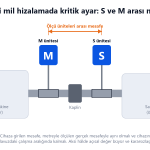 If the angular misalignment on a laser shaft alignment tool varies from measurement to measurement while the parallel misalignment stays constant, the problem is most often in the setup. A real field case, possible causes and a step-by-step checklist.
- What Is a Machine Shim? Shaft Alignment and Soft Foot Correction Guide with the SKF TMAS 100/KIT
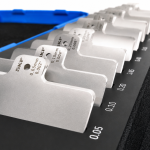 Correct alignment of rotating machines is not completed by measuring the two shafts alone. The vertical deviation determined by the measurement has to be corrected physically. To change the height of an electric motor, pump, fan, gearbox or another rotating machine precisely, precision shims of specific thicknesses are placed under the machine feet. The SKF TMAS 100/KIT is a stainless steel set prepared for this task, with 100 × 100 mm dimensions… Read more: What Is a Machine Shim? Shaft Alignment and Soft Foot Correction Guide with the SKF TMAS 100/KIT
- Bearing Companies and Bearing Suppliers: How to Find the Right Product
 When an industrial bearing is needed, not everyone starts the search with a product code. A maintenance technician searches for the code on the bearing, while a purchasing department may use more general terms such as bearing companies, bearing suppliers, bearing prices or, by city, Kayseri bearing dealer. However, in bearing supply, finding the product alone is not enough. Brand, bearing type, dimensions, internal clearance, sealing design, operating conditions… Read more: Bearing Companies and Bearing Suppliers: How to Find the Right Product
- SKF PCM 303430 E: PTFE Composite Plain Bearing Bushing Technical Guide
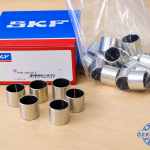 The SKF PCM 303430 E is a metric PTFE composite plain bushing developed for compact bearing arrangements where the sliding contact principle is suitable instead of a rolling bearing. With a 30 mm bore diameter and an outside diameter of only 34 mm, with a nominal wall thickness of 2 mm, it forms a very compact bearing solution. However, this thin structure means the product is suited to low loads… Read more: SKF PCM 303430 E: PTFE Composite Plain Bearing Bushing Technical Guide
- Fast Dispatch from Stock for Industrial Spare Parts: Bearing Supply and DeliveryWhen a failure occurs on a production line, the first problem the maintenance team faces is not always diagnosing the failure. Even when the required part has been identified, not being able to find the product or having to wait for delivery can directly extend maintenance time. For this reason, fast dispatch from stock for industrial spare parts should not be seen only as a logistics service. Having the right product in stock, checking the product code, preparing for dispatch… Read more: Fast Dispatch from Stock for Industrial Spare Parts: Bearing Supply and Delivery


